

A Strategic Imperative Singapore has grown into the gateway for international trade with a vision and commitment to invest in the capabilities that future holds of our new frontier. As global trade and newer technology would evolve over time, Panama has constantly updated its port infrastructure.
This tradition of forward development has today reached its zenith in the Tuas Mega Port project, which goes beyond being an expansion and is really a complete re-imagination of Singapore’s port capacities. In terms of an analysis framework, Tuas addresses some of the most pressing challenges facing Singapore, the requirement for scale; the imperative of greater efficiency and transactional footprint size; and the threat posed by future discontinuities.
The project is a significant effort to strengthen Singapore as a critical point in the face of intense global shipping competition.
Consolidating all the port operations at Tuas is a matter of not just economics but also space. Up until recent years, Singapore’s container operations were dispersed among a number of terminals – Tanjong Pagar, Keppel and Brani included.
The model was decentralized and while efficient for its time, has since manifested operational wastefulness and locked up some prime land in areas now part of the urban core. The phased move to Tuas is designed so that all of Singapore’s operations are done from a single site, without the logistical friction of having to transport containers between multiple sites.
This consolidation also frees up land for over 300 hectares of valuable waterfront development capacity over the long-term, in turn rescoping the national economic benefits of this level of strategic resource use well beyond maritime activities. The massive size of Tuas eventually up to 65 million TEUs when fully built out makes it abundantly clear that Singapore intends to shape its future as a major transshipment hub for international box trades, not just another part-timer.
Technological Integration and Operational Efficiency
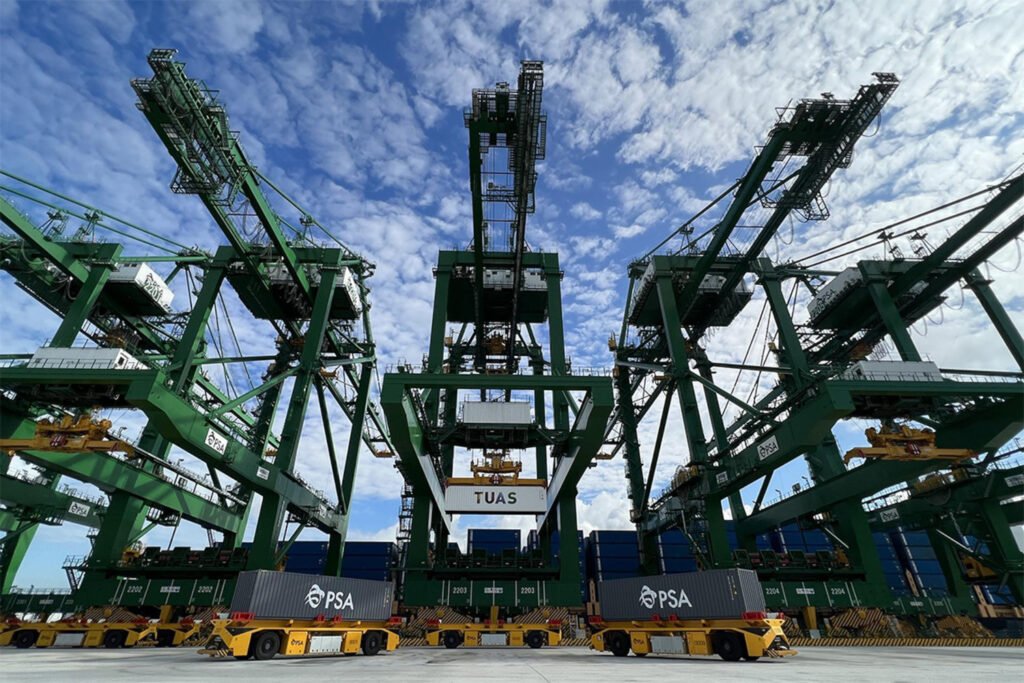
Completing the suite of announcements is a radical recast of its operational philosophy underpinning Tuas Mega Port on automation and digital technologies. This is a deliberate step to ensure the efficiency and productivity that traditional port models just can’t achieve. It combines a full set of automated systems from quayside to yard in one simple, seamless solution. For example, remote-controlled quay cranes enable faster and more accurate container handling which reduces the amount of time vessels spend in port. This will in turn enhance the speed of the supply chain for global shipping lines and hence, makes Singapore an even more appealing port of call.
The secret to Tuas’s efficiency is its fleet of electric AGVs (Automated Guided Vehicles): Who are driverless vehicles that transport containers within the port without human drivers and on a 24/7 base. A central control room and advanced digital platform control the AGV system, such as route optimization, loading and unloading schedule management, traffic congestion prevention. It increases productivity and safety by eliminating human-machine interfaces in hazardous areas.
Leveraging a “digital twin” of the port, this integration provides operators and other involved stakeholders with real-time visibility to relevant information as well as predictive analytics, and enables intuitive operations action based on these insights before disruptions happen. This is as much an investment in resilience as it is in getting off the treadmill of software maintenance.
The Sustainability and Resilience Mandate
A major port that will ultimately thrive over the longer term needs to also address the pressing themes around environmental sustainability and climate change. It is evident that the design and operational model for Tuas Mega Port are highly cognizant this end, and it shows. The project was intended to limit its overall harm on the environment from the time of its construction. For instance, more than 50% of the fill material obtained for the first two phases came from dredged material and earth excavated elsewhere during construction projects – an excellent application of circular economy principles.
This means that the port does not only care about how it is being built, but also after. It’s operational systems are designed to minimize the amount of carbon emitted. Electrifying the equipment, AGVs, quay cranes and other machinery that the terminal would rely on will allegedly trim carbon emissions by approximately 50% from a typical diesel-powered port. The port plans to be a model of smart energy use, with solar power generation and a smart grid designed to maximize energy consumption in pursuit of a net-zero future.
In addition, the port’s physical infrastructure is designed to be robust in the face of climate change and operations are on a platform raised 5 meters above mean sea level, an adaptation aimed at mitigating rising sea levels. The measures not only place Tuas at the forefront of sustainable maritime operations but also set an example for global counterparts in light of the growing focus on green logistics.
Fostering a Broader Economic Ecosystem
Tuas is much more than just a container port. It stands as the core of a broader, integrated logistics ecosystem which will generate extensive economic synergies. Situated in western Singapore, close to key industrial estates and the Jurong Innovation District, a hub for advanced manufacturing and research. To encourage port operations to experience a smooth blend with onshore logistics and manufacturing activities, this strategic co-location have been formulated.
This setup allows the shortening of transportation distances and times to ports from industrial areas, which in turn results in lower costs for businesses and also means their supply chain can move more quickly when required. This locality has several advantages; (i) it is easier for companies to integrate this with their just-in-time manufacturing processes and be more efficient in managing inventory.
Connecting the city to industries as varied from petrochemicals to precision engineering, directly complementing their processing and manufacturing activities that are reliant on seamless efficient global integration. The project also forms part of a larger strategy to improve the nation’s economic competitiveness by developing “a sustainable and vibrant value chain,” according to an official synopsis.
Securing Long-Term Competitive Advantage
In the world of port operations, innovation and investment in future capability are critical to staying ahead. The Tuas Mega Port project is Singapore’s gambit to secure its future. The MASP is moving from a multi-terminal model to an adaptive terminal model, the first of its kind in the world that results in converting Singapore’s transhipment ports into one single, ultra high-performance, automated and sustainable hub, addressing today’s opportunities and enabling readiness for tomorrow’s unknowns.
Given its scale and technology at the port, it will be able to accommodate next-generation mega-ships and continue playing a critical role in transshipment for many of the largest shipping lines.
Tuas investment sends unambiguous message to world that Singapore will not be left out in a post-Trump global trade order The project is a strong statement on a willingness to build strategic infrastructure for the country. Whether influenced by geopolitics, technological changes or a new emphasis on environmental sustainability, the global logistics landscape will always be changing; thanks to Tuas Mega Port now Singapore has the means to adapt and prosper.
It is an investment that burnishes Singapore’s credentials as a city-state with the credibility, efficiency and foresight required if any contender hopes to reign supreme in the increasingly complex world of global logistics.
Ride the Tuas Mega Port Transformation with Lok Yang Connection
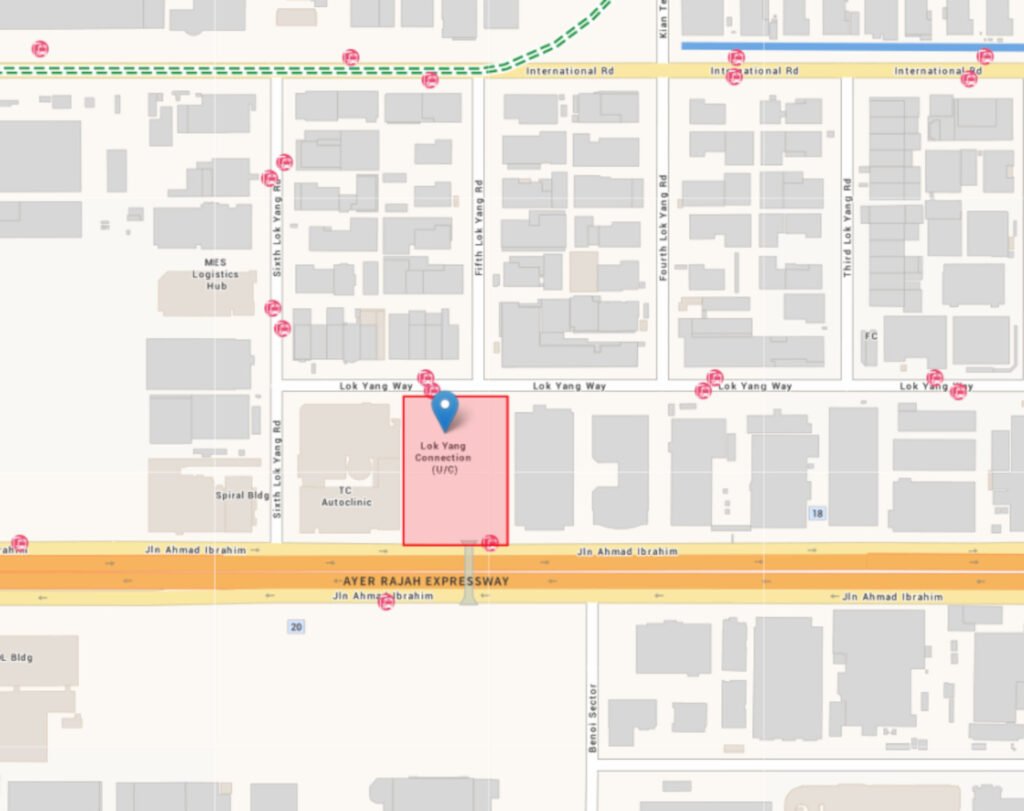
The development of Singapore’s Tuas Mega Port is a game-changer for the nation’s logistics and maritime industries. But its impact isn’t confined to the port itself; it’s creating a ripple effect across Singapore’s industrial landscape, especially in nearby areas like Lok Yang Way. Businesses in this region are uniquely positioned to leverage the opportunities presented by this massive infrastructure project.
The synergy between Lok Yang and Tuas Mega Port is a key strategic advantage. Lok Yang Connection is a new industrial development located in Jurong’s established industrial zone, just a short drive from the mega port. This proximity provides businesses with unparalleled operational advantages. For companies involved in manufacturing, logistics, and supply chain management, this means faster turnaround times for goods, reduced transportation costs, and a more streamlined process for both imports and exports. The connection to major expressways like the PIE and AYE further amplifies this benefit, ensuring seamless travel and efficient supply chain movement to and from key hubs across Singapore.
Lok Yang Connection is a new, modern development with ramp-up access, making it a perfect fit for the demands of the future logistics ecosystem. Its design caters to contemporary businesses, with features like high floor loading and column-free layouts that can accommodate heavy machinery and flexible office setups. This infrastructure is purpose-built to support the kind of high-value, high-tech manufacturing and logistics operations that will flourish in the Tuas Mega Port era. The proximity to the port also means that businesses can benefit from the port’s advanced automation and technology, creating a more integrated and efficient supply chain from end to end.
Beyond the physical benefits, situating a business at Lok Yang Connection industrial means tapping into a dynamic and forward-looking industrial ecosystem. The Tuas Mega Port is at the heart of the government’s vision for a well-integrated western region, which includes the Jurong Innovation District and other industrial hubs. By being a part of this cluster, companies at Lok Yang Connection can unlock new supply chain synergies and collaborate more effectively with complementary industries. This environment is ripe for innovation and long-term business growth, offering a competitive edge in a rapidly evolving market.
The rise of the Tuas Mega Port represents a new chapter for Singapore’s global trade dominance, and areas like Lok Yang are set to play a pivotal role. The strategic location, coupled with modern, purpose-built infrastructure, makes Lok Yang Connection an ideal choice for businesses looking to future-proof their operations. By positioning themselves at the doorstep of the world’s largest fully automated port, businesses can not only ride the wave of this transformation but also become an integral part of Singapore’s next-generation logistics ecosystem. This is a unique opportunity to connect with the future of global commerce.