
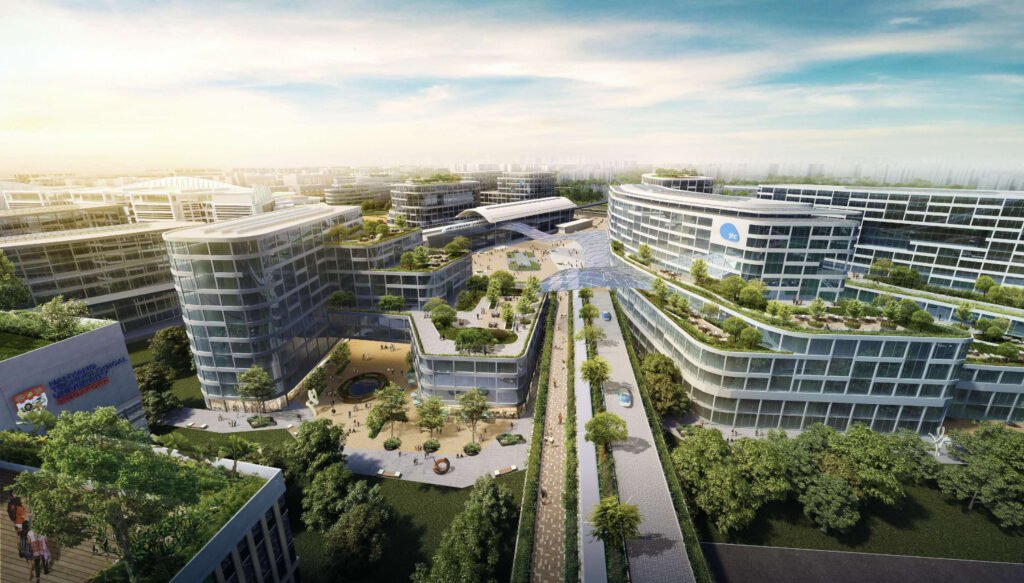
The history of Singapore economic development has involved careful and deliberate evolutionary processes. From the outset of its independence, the new administration identified industrialization as a key pillar for growth and turned swamps in Jurong into an efficient industrial estate.
This district was the country’s industrial heart for years, with factories and warehouses churning to support a growing economy. The Jurong Innovation District (JID) serves as the next and newest iteration in this continuing tale, replacing the conventional industrial park model with a larger innovation hub. It is no mere refurbishment of an age-old estate but a long-term, decades-long blueprint to reimagine the west coast of Singapore in this new economy era shaped by tech and digital.
The entire concept of the Jurong Innovation District is actually a reflection of greater forces at play in contemporary industry. The reality of manufacturing has meant a shift toward these high-value, knowledge-intensive processes, away from low-cost, high-volume production.
Needless to say, Singapore required an industrial space meeting the needs of this future in order to stay competitive. But if JID was designed to be an ecosystem and not just some factories then, The JID is designed to bring all elements of the advanced manufacturing value chain ( R&D, prototyping and full-scale production) together in one integrated location.
But this intentional proximity is central to the intellectual life of JID, where barriers between phases within a business process are abolished and collaboration is encouraged. In a way, this is also a statement on future-oriented land use. As a country with very little land available, Singapore needs to be highly inventive about how it uses this scarce resource. When JTC, the master developer, shells out funds to turn the brownfield of Jurong, full of aging industries, into a thriving, high-tech hub, it is creating huge economic value.
JTC estimates that this 620 hectare district is planned to become an advanced manufacturing hub for Asia. It will be highly densely packed with firms and institutions working in modules that feed off each other’s expertise. This is markedly different from the old model, where factories were simply sold or rented parcels of land that were adjacent to one another.
The JID model is one of creating an intelligent, thinking community that can evolve to meet future challenges and threats, and seize new opportunities. The district is comprised of five precincts namely Nanyang Technological University, Cleantech Park, Bahar, Bulim, and Tengah.
Each precinct has a specific agglomeration of expertise, but they are linked together to operate as a tight unit. As such, the space will support a high degree of specialization, but it is arranged to enable a high degree of cross pollination of ideas. Cleantech Park, for example, can focus on creating sustainable solutions, but firms in other precincts will also be able to tap into that pioneering pool of knowledge.
As such, the planning that has gone into Jurong Innovation District will promote an environment of innovation which will facilitate a high degree of knowledge transfer, as well. Make no mistake, this is an innovation ecosystem in the making – staff from a university lab can meet staff from a multinational just down the hall from a start-up, and collaborate on a terrific new idea in an instant.
A Vibrant Ccosystem Co-Location Model
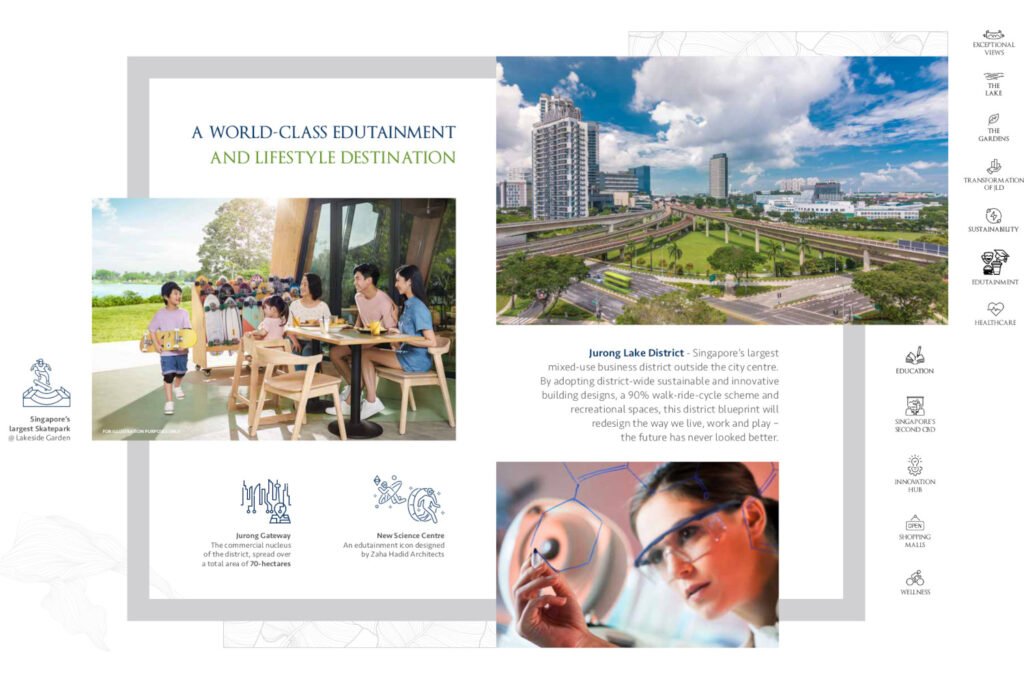
The idea of an ecosystem model sets the Jurong Innovation District apart. The concept is simple, physical proximity will help in collaborative working and aide the journey of idea to revenue. This is a district of academic institutions working in conjunction with research centers, technology providers and advanced manufacturing businesses.
Hence the clustering of functionalities in one place to build an ecosystem of self-catalyzing innovation. For example, a company could innovate on a new product, have it fine-tuned by a research institute in the region and trialled directly on site within a district as its ‘test bed’ to start production without ever actually venturing outside of that immediate environment. This is a potent cure for the fragmented supply chains that plague many of our traditional manufacturing districts.
The type of companies JID has managed to attract is also indicative of the way it is building out its ecosystem. Anchor tenants feature the likes of Siemens, Shimano and Hyundai Motor Group with a mix of high-tech manufacturing and R&D. For example, Siemens has an Advanced Manufacturing Transformation Centre that would assist companies (especially SMEs) to undergo digital transformation with their operations.
Shimano’s ‘Factory of the Future’ with a new intelligent manufacturing plant employing advanced automation for creative cycling components. This attracts smaller companies and startups who feed off that energy of learning from the best in the business. This interconnected web of peers drives innovation at a district level.
But the ecosystem within the district extends far beyond manufacturing. In addition to companies providing some manufacturing process, support services and solution providers fill the rest of the landscape. Ranging from specialized consultants to technology partners who can help these companies adopt and implement Industry 4.0 solutions are present.
Not to mention the entities such as the National Additive Manufacturing Innovation Cluster, or NAMIC, which help companies adopt cutting-edge 3D printing abilities. An end-to-end network such as this is vital to de-risking the fundamental problem of innovation and technology deployment for companies.
A startup can locate every resource it needs to evolve, prototype, and scale its produce. Large corporations can acquire a pool of expert partners in any domain to solve the most difficult problems. The co-location model also permits shared infrastructure and resources to thrive.
Instead of requiring every firm to establish its own lab and facilities, JID gives shared spaces and services like makerspaces and prototyping labs that companies can use. This decreases the barriers to entry for startups and smaller companies and enables them to innovate solitarily without the massive capital expense of constructing their own.
More important, it boosts the effectiveness of usage of resources and reputation. This type of shared infrastructure is a part of JID’s foundation. It is constructed so that firms mix their own operations and gather their edges using corporate infrastructures. As a result, businesses of all sizes may gain from one another’s accumulated advantage.
AcademicIndustry Talent Exchange Engine
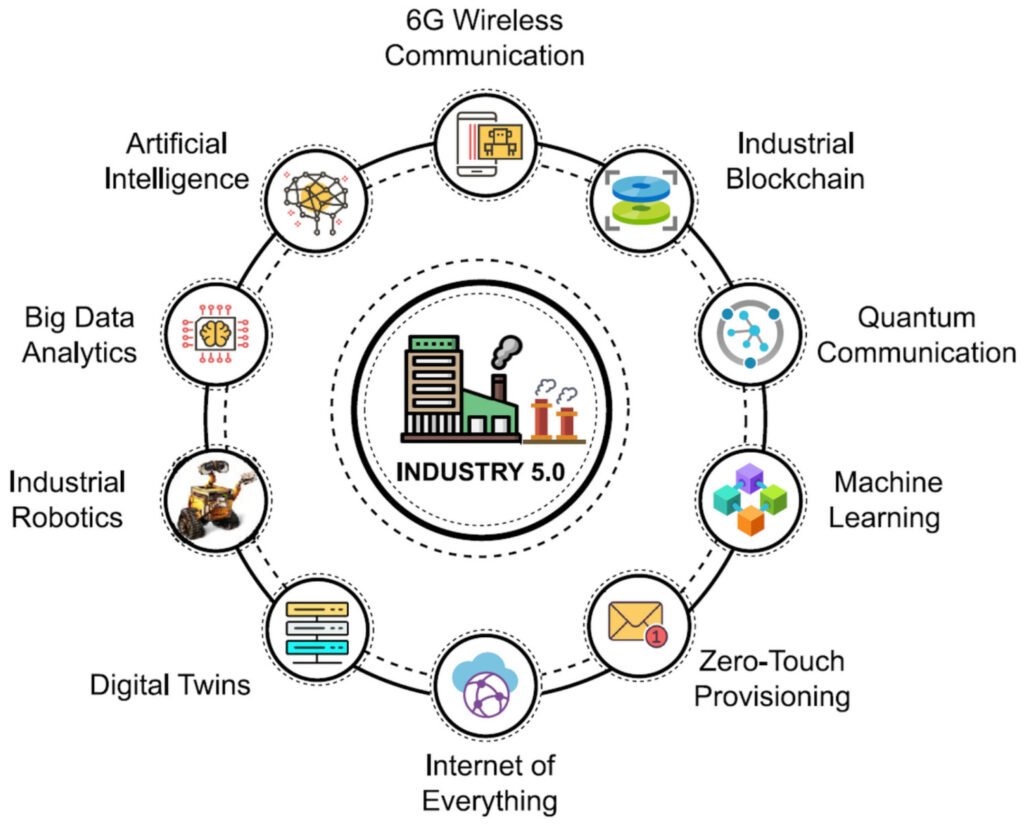
One of the pillars of the JID strategy is an emphasis on building a strong talent pipeline. What this new era of advanced manufacturing needs is a workforce with an equally sophisticated skill set, one that covers everything from robotics, data analytics, and artificial intelligence to traditional engineering.
The district responds to this need directly by having strong symbiotic relationships with education institutions. One particularly potent example of this strategy is the co-location of Nanyang Technological University (NTU) with the district. While in the case of NTU — it supplies companies with a pipeline of fresh graduates and researchers who can be immediately deployed, providing new thinking and high level theoretical build, to complement the work happening on the industrial ground. This proximity leads to a sort of collaboration that is hard to achieve in traditional industrial territories.
In addition to producing the graduates, JID also aims to place great emphasis on lifelong learning and continued upskilling of the existing workforce. That is an important adaptation for a country with a mature economy, where upgrading the skills base is an unavoidable requirement to remain economically competitive.
Additionally, training centres such as the Advanced Manufacturing Training Academy (AMTA) and the Bosch Rexroth Regional Training Centre are located in the district delivering tailored training programs in advanced manufacturing. These centers collaborate with businesses to determine labor shortages, and create curricula that confront the development of new technology in order to provide a skilled workforce. This emphasis on lifelong learning is an essential longterm human capital investment.
The district has also defined an approach to talent development including making Long Beach a sought-after and desirable place for the best educators. The JID is not just an office space but we intended it to be a place of learning, networking and rejuvenation. The urban design philosophy behind it, a way to help attract new-age workers who like the ideal of being able to work and get many of the amenities they need everyday right out their front door.
JID aspires to attract talent by offering green open spaces, amenities, and connectivity; in other words: JID aims to be a place in Toronto where the best minds of tomorrow want to be and feel they can contribute. Accordingly, the talent strategy is highlevel covering formal education to its current workspace.
JID´s collaboration between academia and industry also influence educational institutions on what to teach, facilitating an education that is more in tune with the market real demands. Businesses help by trying out a new technology before universities and polytechnics can get feedback from the real world.
This feedback loop ensures that the education provided to students continues to be relevant and matched with industry requirements. If a company is developing technology for autonomous vehicles, it could work with NTU’s research centre to design fresh training modules to help students prepare for a career in this field. And because the education system is so closely attuned with industry, it’s pretty much guaranteed that today’s workers are groomed for whatever economy brings.
To attract first-movers and encourage further experimentation, we were one of the first Districts in Jurong, and among the first in Singapore, to implement a living lab concept. In essence, JID is a large-scale test-bed where new technologies can be piloted and honed in a real-world setting.
This accelerates the pace of development and commercialization of these new solutions in two ways. For one, it enables innovators to move beyond theoretical models and understand how their ideas work in a live working environment. It also drastically reduces the time and resources needed to bring a new radical and unproven technology to market. As a result, JID provides a sandbox environment that is a magnet for companies developing the latest solutions, be it in robotics, energy storage, or other cutting-edge sectors.
A leading example of the living lab concept in JID is CETRAN. CETRAN is a Centre of Excellence for Testing & Research of Autonomous Vehicles, developed by NTU and the Land Transport Authority. CETRAN is a dedicated test facility for AVs, with a wide range of road scenarios, including the most complex traffic junctions and simulated tunnels.
Companies can test their proven solutions of driverless vehicles in a safe and controlled environment. The infrastructure is thus a pull factor for numerous companies in the autonomous mobility space, as it allows them to glean the insights and data they need to speed up their development cycles. These trials feed into national legislation, and they aid preparations for the deployment of AVs to ensure that Singapore’s roads are ready for the AV revolution to come.
The autonomous vehicles are just one transformative technology that JID is testing. The district is a 5G trial zone, particularly looking at how the latest mobile technology could be used in manufacturing and logistics. They are also testing 5G for realizing Smart Factory scenarios, with which manufacturing plants can use real-time data analytics to automate systems faster and near instantly share computer-generated information with field workers who don’t need to have physical access to the factory by using a combination of augmented reality overlays.
The test-bedding of 5G technologies enables businesses understand reality and pragmatically assess business application scenarios, flesh out practical benefits or reveal impediments to 5G- based implementation while providing a rich vein of data for use by telcos and technology providers. Sri City (Tamil Nadu, India) The district is a sandbox for the future of industrial technology.